Sunshine Golden Retriever Rescue
  • Home
  • About Our Rescue
    • Meet Our Rescuers
    • Contact Us
    • Disclaimer
  • Adoption Info
    • Adoptable Dogs
    • Adoption Info
    • Courtesy Postings
    • Why A Golden?
    • Adoption Fees
    • Adoption Application
    • Adoption Contract
    • Setting Up for Success
    • Microchips
    • Happy Tails 2026 >
      • Happy Tails 2025
      • Happy Tails 2024
      • Happy Tails 2023
      • Happy Tails 2022
      • Happy Tails 2021
      • Happy Tails 2020
      • Happy Tails 2019
      • Happy Tails 2018
      • Happy Tails 2017
      • Happy Tails 2016
      • Happy Tails! 2014-2015
    • Adoption Stories
    • Forever Fosters
    • Going Home
    • Slip Leads REQUIRED!
    • Crate Training
    • Separation Anxiety
    • Black Goldens
    • Adopting a Blind Dog
    • Wendy's Rescue
  • Surrendering Your Dog
    • Intake Form
    • Vet Records Authorization Release
    • Keeping Your Dog
  • Fostering
  • How You Can Help
    • Volunteer >
      • Volunteer
  • Is it Time to Say Goodbye?
  • Education & Healthcare
    • Heartworm Information
    • AKC Alternative Listing Process
    • The Morris Foundation
  • Trainers
  • Get to Know Us!
  • Paypal & Credit Cards
  • Tributes
  • Rainbow Bridge
    • Rainbow Bridge 1
    • Rainbow Bridge 2
    • Sunshine Angels
  • Donation Opportunities
    • The Memphis Legacy Fund
  • Bequests
  • Members Only
Picture

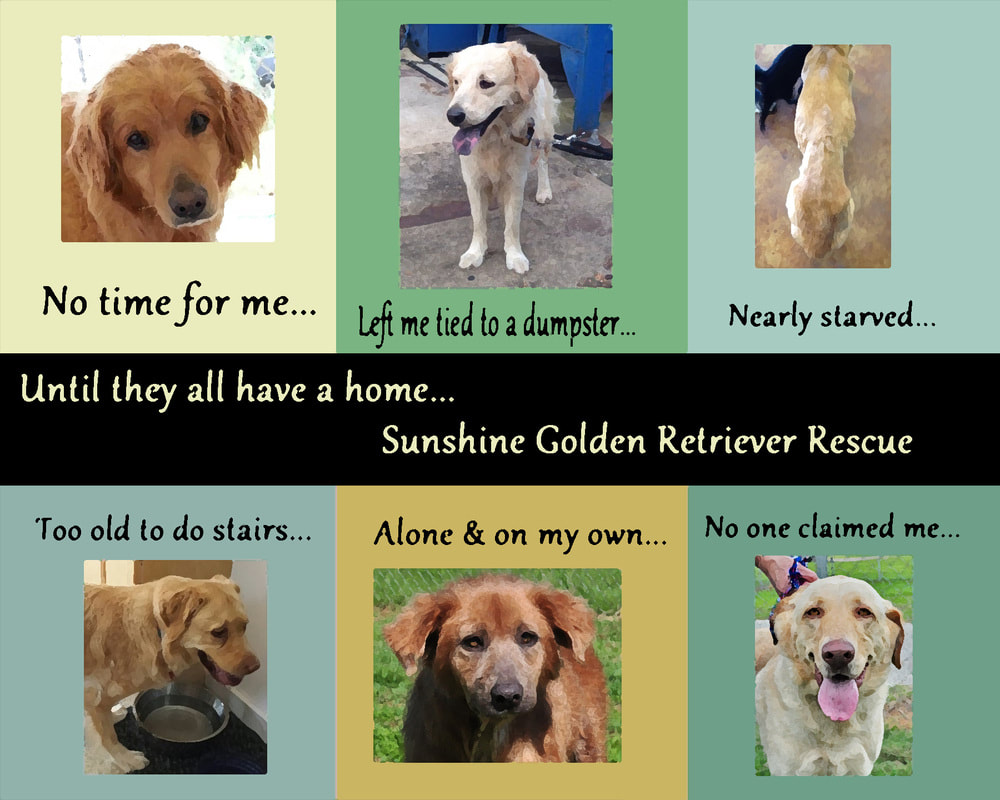
Serving CT, ME, MA, Eastern NY, NJ, NH, RI, & VT, Sunshine Golden Retriever Rescue is a 501c3 registered dog rescue group.  Since 2005, the volunteers of SGRR have rescued Golden Retrievers, Golden mixes, and Golden-hearted dogs who have been abandoned, abused, or relinquished by their owners.  We are dedicated to finding the best possible homes for these dogs in need.

Independence Day 

Picture
Picture

Summertime Safety

Picture
The following article from the Hill’s Pet website is a good reminder, as we are in our warmest months, of precautions we should take and signs we should recognize to keep our dogs comfortable and safe.  Please take a couple of minutes to read it.  Our dogs are depending on us!

Overheating in dogs is not something to take lightly. As the weather heats up, it's important to remain aware of how the heat affects your pup. Heat exhaustion in dogs can lead to serious and potentially fatal conditions such as heat stroke and cardiac arrest. To help keep your dog safe and cool during the summer, here is the lowdown on signs that he’s overheating and how to prevent it: hint, a little water does wonders for keeping your pup cool.


Heat Exhaustion and Heat Stroke
Unlike people, dogs don't sweat out excess body heat. While your dog does have a few sweat glands located in his paws, these do little to help regulate his body temperature. Instead, he does this through rapid, open-mouthed breathing, called panting. But sometimes panting isn't enough to keep him from getting overheated.
Heat exhaustion in dogs can occur when the body temperature becomes elevated above the normal temperature. This varies slightly, according to PetMD.com, but it's generally agreed that temperatures of 103 degrees Fahrenheit and higher are above normal. If the temperature continues to rise and reaches 106 or higher, your pup is in the danger zone for heat stroke, during which the organs begin to shut down and his heart could stop altogether.


Warning Signs
Fortunately, it's not difficult to spot signs of overheating in dogs. Excessive panting is the first symptom. A dangerously overheated dog, according to the American Kennel Club Canine Health Foundation, may collapse or experience convulsions, exhibit vomiting or diarrhea, and may also have gums or a tongue that turn blue or bright red. You may want to identify the problem before it gets that severe, though to intervene and prevent serious overheating. Early signs are more subtle - it may be as simple as your dog seems less responsive to commands than usual. When you call his name, instead of turning to look at you, he may wander away. If there is any question at all, get your dog out of the heat. The Humane Society of the United States adds that signs of potential heat stroke include glazed eyes, excessive drooling, a rapid heart rate, dizziness or lack of coordination, fever, lethargy, and loss of consciousness.


Risk Factors
While all dogs are at risk for overheating if the conditions are right, some breeds are more prone to it than others. This includes dogs with thick coats or long hair, very young or very old dogs, and brachycephalic breeds—those with short noses and flat faces, such as shih tzus, pugs, boxers, and bulldogs. Overweight dogs and those that suffer from medical conditions that cause difficulty breathing or heart problems are especially susceptible.
Extremely active dogs and working or hunting breeds (such as shepherds, retrievers, and spaniels) are also at a higher risk, especially during warm months. You should be careful to not push these dogs too hard, so make sure they get plenty of breaks to rest in the shade and that they are well-hydrated at all times.
Environmental factors can also place a dog at risk. Be aware not just of high temperatures, but also of high humidity, which can increase the chance of heat exhaustion in dogs. All dogs are at increased risk of overheating if they're not given adequate shade or another cooler place to relax indoors. And dogs left in a hot car are in serious danger of heat exhaustion and heat stroke.


What to Do if Your Dog Is Overheated
At the first sign of overheating, immediately take action to cool down your dog. Vetstreet recommends the following steps to treat heat exhaustion in dogs:
  1. Immediately move your dog to a cooler area, either indoors where there is air conditioning or in the shade under a fan.
  2. Use a rectal thermometer to check his temperature. Heat exhaustion typically occurs when a dog's temperature falls between 103 and 106 degrees. A temperature above 106 places him at risk for heat stroke. If he's in the danger zone, call your veterinarian.
  3. If you're near a body of fresh water, such as a lake or a baby pool, let your dog take a dip to cool down. Otherwise, you can use cool, wet cloths or towels to help him out. Place your cool wet cloths on his neck, armpits, and between his hind legs, and you can also gently wet his ears and paw pads with cool water.
  4. If he's conscious and willing to drink, give him cool, fresh water. Don't force it, however, as it may end up in his lungs. If he can't or won't drink, or can't keep water down, wet his tongue with water instead. Don't feed him ice cubes, which could cause his temperature to drop too quickly, leading to shock.
  5. Get him to the vet. If you haven't already done so, call ahead so they can be ready to take immediate action as soon as you arrive


Avoiding Heat Exhaustion in Dogs
Of course, the best cure is prevention. You can help keep your pooch from overheating with some basic safety practices. These include limiting exercise or outdoor activity on excessively hot or humid days, providing plenty of shade and water when your dog is outdoors, and NEVER, under any circumstances, leaving your pet in a parked car—not even in the shade with the windows rolled down. On mild days with temperatures in the 70s, the inside of a parked car can reach 120 degrees in minutes, making this an extremely dangerous environment to leave your dog, even for a short time.

If your pooch has energy to burn and needs some form of exercise in order to stay calm, take him swimming or let him run and play in the sprinkler before heading back indoors. You can also use a cooling body wrap or vest to help keep him cool without getting him wet. 

Additionally, if you take your dog on long walks it might be better to take him during the cooler hours of the day such as early in the morning or later in the evening (keep in mind hot sidewalks and pavement can burn his footpads). Be sure to keep water with you and let him take a break every once in a while. If you run with your dog make sure to not overdo it. Just as hotter temperatures make it harder for you to stay hydrated on a nice run, it's even more true for your pup.

If you'll be hunting or hiking with your dog, or if he has a job to do such as herding sheep or cattle, be sure to give your dog several breaks in the shade and make sure he has plenty of fresh water. Consider wetting him down or using a cooling vest while he's active, and keep a close watch on him for the first signs of overheating. Remember that working dogs tend to become so focused on their tasks that they don't realize when they need to rest and cool down. It's up to you to monitor your dog and make sure he gets the breaks he needs to stay healthy.

Finally, don't forget to put a plan in place for keeping your dog cool if the power goes out or the air conditioner stops working. As uncomfortable as you might be under such conditions, it's even worse for your dog, whose body temperature is already much higher than yours. If you plan to retreat to someplace cooler, be sure he'll also be welcome. Otherwise, consider leaving him at a kennel until it's safe for him to return home to cooler conditions.
Armed with the knowledge of how to recognize overheating, how to respond and how to avoid it in the first place, you can look forward to a safe, fun and happy summer with your four-legged friend.


Why Rescue?

Picture

Our Goldens and Golden-hearted dogs make wonderful pets.  We want our applicants to also know that rescued dogs come from a variety of backgrounds. Some dogs are older dogs, including well-behaved and cared for pets whose owners have become ill or died.  Many rescued dogs will require continued behavioral work due to a lack of training, neglect, or abuse in the dog’s previous setting. A patient and loving owner can make all the difference.  From experience, we know that these dogs with “endearing imperfections” can move forward, provided their new family gives them necessary guidance and direction. The joys of seeing these dogs become the devoted and contented pets they were meant to be is remarkable. 
Adoptable Dogs

The 3-3-3 Rule of Adopting a Rescue Dog

Picture
Congratulations! You’ve just adopted a new dog!   Like humans who move to a new community, your new pet needs some time to get used to their new surroundings.  That’s why SGRR's adoption coordinators talk about the "Rule of Three," a timeline that gives you an idea of how your dog will adjust after three days, three weeks, and three months.

Here’s what should happen three days after you acquire a new dog:
  • This is a major period of adjustment, because while your home may be roomy and inviting, the dog has to get used to living in an environment different from an animal shelter or their previous home.
  • A dog may sleep a lot in the first three days, or be easily aroused or excited by its new surroundings. This all depends on the animal’s personality.
  • The pet will need to learn what is good or bad behavior in your house. For example, no sleeping on the furniture, no gnawing on shoes like they are chew toys, no going potty in the house.
  • Be patient with your dog in these opening days, and give them plenty of time and patience. Perhaps your pet will need positive-reinforcement training classes so it properly behaves in your house, but keep in mind, improvements are on the horizon!

After three weeks:
  • The dog will be more used to your daily routine such as when it is time to take a walk and when it is feeding time.
  • You will see more of the dog’s personality begin to develop, and they should be less fearful than those opening days when they first arrived at your home.
  • By this time, you will have narrowed down the dog’s behavioral problems considerably. A dog training professional can help teach the dog the difference between what’s right and wrong, if there are any persistent issues.

After three months:
  • Most dogs know they are welcome in your home and understand the rules.
  • Your patience will have paid off, and the two of you can live together and become lifelong companions!

Picture
Picture
Picture

New to SGRR...?

Want to Learn More About Us...?

We at Sunshine Golden Retriever Rescue take the job of finding the best possible forever homes for our dogs very seriously.  The adoption process is thorough so that we can learn as much as possible about those to whom we entrust our precious pups.  Once a dog is placed with an approved adopter, they are welcomed into the SGRR family and given the tools and support to make the adoption successful.  We have gathered comments from some of our adopters who are happy to tell you how they feel about us!  You can read more comments on our Get to Know Us! page.

Kelly

One of our adopters created this cool video to tell you about his experiences with SGRR.   We are excited and proud to share it with all of you.  Click the button below and enjoy!
Jack & SGRR

Support SGRR While You Shop through iGive

Picture
Click to shop at iGive
Shop at 1,000+ Top-Notch Online Stores.  The iGive mall includes: Pottery Barn, REI, Staples, Petco, Expedia, Best Buy, QVC and many more. Best of all, up to 26% of your purchase at each store is donated to SGRR when you sign up with the provided link.


Donate to SGRR or Pay the Adoption Fee

There are a number of ways to donate to SGRR.  SGRR is designated as a 501c(3) organization which means your donations are tax-deductible.  You can make a donation to our general fund or designate your donation for a specific purpose such as a memorial or a tribute.  Please use the Paypal option below or mail a check to:  SGRR, PO Box 403,  Fairhope, AL  36533.

Paypal

Single Payment
Use for a single donation or to pay an adoption fee.
Recurring Donation

Venmo

PictureClick to be directed to Venmo

You may use Venmo to make a donation or to pay the adoption fee when you are matched with a dog.  


Payments through Venmo should be sent to:  SGRR (our account match shows as SGRR Corp with our logo)

Sponsor a Dog

Picture


If you would like to provide for the care of a particular dog's needs, you may sponsor that dog.  Please use  Paypal or  mail a check to:  SGRR, PO Box 403,  Fairhope, AL  36533.  We will then note you as a sponsor on the dog's dedicated bio page. 

We thank you in advance for your generous support! 


We  LIKE  You  Too!

Picture
Click to visit our Facebook page!
Picture

Picture
            HOME    Contact Us    Adoption Info    Adopting a Golden    Adoptable Dogs      Adoption Contract   
Bringing Your Dog Home    Post Heartworm Care        Volunteer     Fostering    Surrendering Your Dog    Training Tips & Advice   
Running with your Dog
    Health & Safety     Rainbow Bridge    Tributes
            Web Hosting by iPage                                                                                                                              Webmaster:   Donna Toncic
  • Home
  • About Our Rescue
    • Meet Our Rescuers
    • Contact Us
    • Disclaimer
  • Adoption Info
    • Adoptable Dogs
    • Adoption Info
    • Courtesy Postings
    • Why A Golden?
    • Adoption Fees
    • Adoption Application
    • Adoption Contract
    • Setting Up for Success
    • Microchips
    • Happy Tails 2026 >
      • Happy Tails 2025
      • Happy Tails 2024
      • Happy Tails 2023
      • Happy Tails 2022
      • Happy Tails 2021
      • Happy Tails 2020
      • Happy Tails 2019
      • Happy Tails 2018
      • Happy Tails 2017
      • Happy Tails 2016
      • Happy Tails! 2014-2015
    • Adoption Stories
    • Forever Fosters
    • Going Home
    • Slip Leads REQUIRED!
    • Crate Training
    • Separation Anxiety
    • Black Goldens
    • Adopting a Blind Dog
    • Wendy's Rescue
  • Surrendering Your Dog
    • Intake Form
    • Vet Records Authorization Release
    • Keeping Your Dog
  • Fostering
  • How You Can Help
    • Volunteer >
      • Volunteer
  • Is it Time to Say Goodbye?
  • Education & Healthcare
    • Heartworm Information
    • AKC Alternative Listing Process
    • The Morris Foundation
  • Trainers
  • Get to Know Us!
  • Paypal & Credit Cards
  • Tributes
  • Rainbow Bridge
    • Rainbow Bridge 1
    • Rainbow Bridge 2
    • Sunshine Angels
  • Donation Opportunities
    • The Memphis Legacy Fund
  • Bequests
  • Members Only